Sunday, April 21, 2013

Lessons in Life...From the Moscow Circus.

The Djigits of Central Asia -- Knights of Islam

[Note concerning the week's events.]  Probably not the best week to be visiting central Asia, but then I really do not have issues, antagonisms, unfounded fears, grudges; any need to resent the entire Islamic world.  I actually do not give theology much thought outside the historical context of religion in the world's many cultures...and clashes.  Yes, a metaphysical marriage exists -- a powerful one, but since I do not believe in any version of God, nor the man-made interpretation of the many perceived doctrines of Gods, I tend to disregard most mortal translations -- of any stripe.  However, given that premise, I do have a few highly personal issues with some of the more radical adherents of Islam, or for that matter, any sectarian group or belief system that supports a linkage between a message of compassion and the violence of random, politically motivated acts.

For you see, this broader sectarian zealousness did kill a friend of mine in the WTC debacle...a Muslim I might add.  One of the very disciples of the same Islam directing the actions of the man sitting in the cockpit.  My friend was a man that had spent his rather abbreviated life practicing what much of the Quran teaches...and as I am told, the Bible mirrors in its own message of love, compassion, and quite sadly, the coercive message of absolutism.  Adherents of both faiths know well how these sacred words can get lost, misappropriated; perhaps struck redundant in a blinding moment of anger or hurt.  Messages twisted and perverted by political agendas; personal gain.  But the truth for me is that I live in history.  That means I look for answers in the origins of the question.  And no, it doesn't make senseless violence (from whatever distant camp), any more palatable.  Yes, I grieve for lost lives, but I will refuse to accept the rationalizations pouring from the ecclesiastical palaces who shout of a righteous dogma while their loyal congregations merely tithe with the coin of the realm -- unwilling to convert those gentle words into deliberate and singular action.  And for those who attempt to usurp this broader message in order to legitimize the right and wrong of the thing...there is none to be found.  There is only the hope of ending a cycle -- one person at a time saying, "Enough."]


When elephants fight…it is the grass that suffers.

                                              Kikuyu proverb

       
  So...now a story of other people, other times. One that sadly holds parallels beyond the mere love of horses.


Only 1000 Years to Get from Here To There...


The Long, Slow Road from Violence...to a Grand Entertainment:  
The wonderful thing about horses is how, over history, they have helped shape the geo-political landscape of the world we know today.  Kings, princess and moguls often get most of the credit -- scorn as well, perhaps but the great earth-shakers of our past -- with their vast and terrible armies -- would not have wandered far without the greatest single tool in their arsenal:  the horse.  And while these armies spread carnage and bloodshed to the far corners of an emerging civilization, they also left in their wake, the science, religion, technology, art and philosophy of distant and unknown lands.  The cultural pollination of an entire planet.

In 1988, and again in 1989, I was granted the rather incredible opportunity to spend a couple of weeks with the Moscow Circus while it was touring in the United States...courtesy of a thaw in the relations between the Soviet Union and the United States -- Mikhail Gorbachev's diplomatic overture he coined Perestroika.  Out of this rare opportunity, I produced a number of articles, including pieces for both EQUUS magazine and The Chronicle of the Horse, both quoted here. My initial assumption was that I would be visiting the Russian version of Buffalo Bill's Wild West Show...only with trapeze artists, bears and the occasional clown.  I also had no idea that this story would introduce me to the Islamic world -- a history marked by rapid expansion, great cultural influence, harsh defeats and always: the faith.  
  [Note: Original articles in bold; not always in context here.
 Current annotations will be *italicized.]

It has often been said that when it comes to horsemen, the common ground is wherever a horse happens to be standing.  Similarities in the relationship between man and horse, be they Soviet or American, cross cultural barriers as easily as modern man crosses a continent.  The 1988-89 American tour of the Moscow Circus, featuring equestrian acts overseen by trainer Tamerlan Nugzarov, proved that with the horse as diplomat, there is little room for politics.  The Russian performances, based on horsemanship of the first order, spoke in a language as understandable to Texans as to Soviet citizens.     

Tamerlan, like many of these Djigit riders come from the vast
steppes of Central Asia-- the Caucasus's. It is a tribal region,
primarily Islamic, but with many other cultural, ethnic and
 religious influences as well.  Much like  present-day
 Afghanistan in its never-ending complexities.
Nugzarov is a fourth-generation horseman.  Raised in soviet Georgia, near the Caucasus Mountains, he has trained horses and horsemen for nearly 30 years. "I learned everything from my father," Nugzarov says, "just as he learned everything from his."
Tamerlan Nugzarov, a Soviet Artist of the State
Perhaps that fact alone separates the ideologies of two very different worlds.  While Americans pursue the future with a zealous passion, many Soviets find solace and a proper place in time by following the well-established trail set by their ancestors.  And the road to the circus, much like the one that leads to American rodeo, is based on the culture and history of the people.

*Important to remember that in 1987 (regardless of a warming in relations), security was tight -- mostly due to the ongoing concern over possible defections -- a thorny issue on both sides.  I was always accompanied by a woman identified as a 'cultural affairs officer.'  Definition:  KGB with jewelry.  In the two sessions I had with the Moscow Circus, the first was while the Soviet Union still existed, the second following the collapse. 
Horses have always played a major role in the Moscow Circus, which was making its first tour of America in more than 10 years. This year's troupe, like the previous tours, is a condensed representation of the more than 137 separate circuses that comprise the Moscow Circus.  Unlike its American counterparts, the Soyuzgocirck, as it is called in Russia, is a cultural institution, entertaining more than 70 million Soviet citizens a year and employing over 24,000 people.  And in the hearts of the citizenry, it is of equal stature with the best of theatre and opera.
*Central Asia has always  been extremely tribal in nature, to the point that one could easily assume that the inhabitants hated just about everybody.  In purely geo-political terms these tribes never recognized any form of national boundary up until the forced consolidation within the USSR.  The various tribes and confederations extended into China, Iran, Afghanistan, Ukraine, the Balkans and much of southern and eastern Russia.  Of note, these groups were often lumped together historically as Cossacks, though that distinction is far from accurate.  The entire  region has a long history as a migratory and trade route, often coveted by foreign powers for the immense fertility found throughout its immense and diverse geography. This created the vast cultural diversity of the region and perhaps the fierce independence of the inhabitants.

 That spirit was quite evident well into the 20th century when these groups fought a long and protracted action against the Bolshevik forces during the Russian Revolution.  And contrary to popular mythology, many of these regional groups actually joined elements of the German Army in World War II (XVth SS Cossack Cavalry) -- not so much  'for' Germany, as 'against' the Soviet Union.  This resistance continued throughout the 20th century, through the collapse of the Soviet Union and beyond. Uzbek, Kyrzig and Chechen nationalism -- as well as many other ethnic minorities continue to agitate, sometimes violently, for greater autonomy or complete independence from Moscow -- and concurrently, an appeal to the eastern powers in Beijing, as many of these ethnic groups (as in the case of Inner and Outer Mongolia), are separated over the many arbitrary border disputes by the greater powers.  More on this as we try to recount a story that becomes more complicated by the day.      


Djigits of Another Era

*To quote: "In the dramatic history of the Uzbeks, the Lakai were inveterate scene stealer's.  Today's Lakai are proud of their historic roles as horsemen, fighters and brigands.  Though few in number and poor in resources, they never hesitated to challenge greater powers.  Emirs, tsars and commissars attempted to annihilate them, foreign travelers maligned them.  Their neighbors, with good reason, disliked them."  Oh, and as a side-note, many migrated into northern Afghanistan over the last century -- many joining the ranks of the Mujaheddin....aka, the Taliban, fighters with very different roots, bound in the common denominator of removing outside interference in their homelands.  A seductive appeal in a largely illiterate population.   
"The riders train themselves."  Nugzarov continues.  "The tricks they think up themselves.  What is good is that the state provides them with everything.  It pays for rehearsal, for training, for everything.  At home we have rehearsals every day for three hours.  It is simple.  Practice is much better than theory."

*Here is where we both have an an attack of naivete and play the party line for Ms. KGB.  Later, in private, over a cup of tea, we discussed the difficulties and challenges of maintaining the horses -- life itself  in the Soviet state.  One that appeared to be crumbling under its own weight as we spoke. We both smiled...a silent kind of agreement and let the conversation wander to the acts themselves... the horses and those small details in the performance that the audience never knows about.  After all, it is show business to those folks in the stands.

[Flags of the 'stan's.'  From the Indo-Iranian (Persian) word, stanam, or staan; it denotes the "land or country of"...a nod really to the tribal origins of its inhabitants.] 

Nugzarov's act incorporates a little elementary dressage, a good deal of trick riding and just enough sword play to keep it interesting.  The horse's gallop in a 30-meter (44-foot) ring, with banked surfaces, coated in rubber -- and the dimensions are important.  As Nugzarov explains it, "There are 11 to 13 gallopades [strides] to the circle.  The horse is moving very quickly, so it seems to the audience that there is great speed.  Actually, they are fooling the audience, and if the circle were bigger, it would seem much slower.  But of course, the smaller circle is much more difficult."

The rubber surface is meant to cushion the horses and flexes in any direction when a leg rotates on it.  Nugzarov admits to some problems with ankles and shoulders on the horses, but after five months of touring, and more than a few [equine] teenagers in the group, all seemed sound  and performing well.  Nugzarov said, "The horses cross-canter, mostly because of the diameter of the circle, but also to accomodate the riders rolling under them."

The horses are all picked out personally by Nugzarov as 2-year olds.  "We buy the horses and begin training them and strengenthing their muscles.  They begin training at 3.  A horse is strong enough at this age.  At 2 they just do ground work.  I choose them by their height, by their strength, and by their muscles."


The horses all work to the left, because as Nugzarov states, "this is how they are still in their mothers.  From the beginning, it is natural for them to turn to the left."  However, the horses are sometimes rehearsed going to the right, and at home they are ridden outside, often on the streets or in the fields.

      The horses:  Because of deeply rooted cultural beliefs, as well as a training philosophy, Nugzarov works only with stallions.  "Nature protests against castration, and the horse loses his fire," he says.  "It is not the right way.  The audience feels that the horse is not as beautiful or as real."

It may be a measure of of his ability and his patience that eight stallions can live and work in the confines necessitated by a long tour.  The horses live in over sized tie stalls, each within easy reach of the next horse.  Most tour facilities require that the horses warm up backstage in the equine version of afternoon gridlock.  Cooling out requires the same degree of tolerance, and the eight stallions tend to regard each other as companions rather than rivals.

*I actually rode one backstage in the warm-up phase of the act.  Their behavior was exemplary -- not what one would expect.  And as a nod to the horse's needs, they always performed last -- giving the grooms and trainers full use of the facilities for cooling them out. The horses were kept barefoot, maintained quite well.  One 'trainer' (I note this as they do not refer to themselves as riders -- only trainers), also handled the farrier work.  His tools were typical of Soviet manufacturing: abominable; his rasp had no teeth left. In the spirit of good foreign relations....he left with GE nippers, Victoria knives, a box of Bellota rasps and a hoof stand -- a tool he had never even seen.  Ms. KBG was a little chagrined...later I brought her flowers and Ghiardelli chocolates.  The interviews improved after that.  If anyone actually believes that the average Russian was ever brainwashed...fully indoctrinated to the party line...a good little communist -- think again.  When faced with no tangible options, you 'go along to get along.'  Nugzarov's chief concern was finding enough rubles to keep his horses, his troupe and their families intact.  Oh later, Ms. KGB passed me a note in broken English: "Can you get this panties, hoses I think...black maybe...I will pay you okay."  Super power diplomacy does have its moments.  

The horses used for the dressage portion of the act [cadre noir] are half Arabian and half English import.  For the most part, they resemble a small Warmblood with an Arab head.  The vaulting horses are mostly Akhal-Tekes, a breed of horse that is as old as the Russian culture itself.  At about 16-hands, they are the largest horses in the act and are well-known for their unique bronze color.  Also in the act are a Hanoverian, a Budyonny -- a relatively new Russian breed, developed as a cavalry mount -- AND an American Quarter Horse that joined the circus during its 1978 tour.  During that tour, a Denver attorney presented Nugzarov with a Western saddle and bridle.  Ten years later, he still rides with the saddle in his act -- though it has been battered by the years of hard riding, he steadfastly refuses to replace it. 
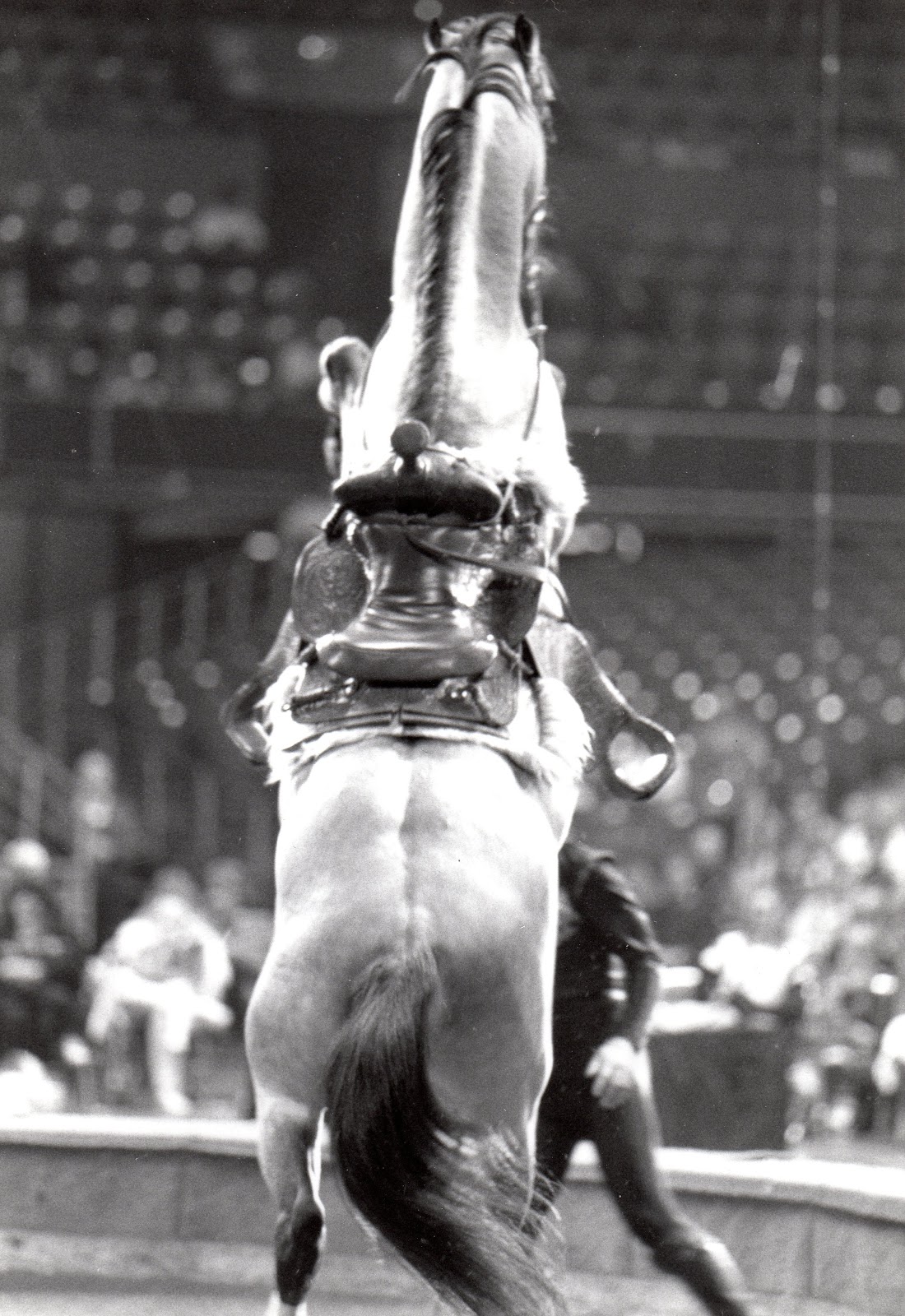
This ain't no Russian horse...
*Ah yes, the mystery horse from Texas.  Seems someone swapped a couple of equine passports and one of the troupe's Akhal-Tekes failed to go back to Russia. (An equine defection.)  Akhal-Tekes are coveted in much of the world as endurance horses.  Unfortunately, due to their origins in central Asia, most are EIA reactive -- meaning they cannot pass a Coggin's Test.  Hence, they can't be imported even though they are not exhibiting the disease or capable of transmitting it.  However, once out of ear-shot of Ms. KGB, Nugzarov confessed to a little horse trading -- Texas style.  And yeah, a Dallas lawyer was in the middle of it. The rest, as they say is, "Classified."   

In other circles, where performers use horses as Nugzarov and his riders do, the animal might come to be regarded as nothing more than ceremonial accompaniments.  But Nugzarov allows no prima donnas.  Each rider (trainer) must also wrap legs, clean stalls and tack, warm up and cool out the horses and participate in three hours of rehearsal daily.

Of course there are also some risks.  "Yes, there have been injuries," Nugzarov says, "but they have not been major.  After all," he adds with a hint of Russian fatalism, "the hardest injuries are those to the soul."   

Backstage...Not Very Different from Your Average Horseshow...Schooling Time!
And after each performance, all the horses get their own head of cabbage as a reward. No, not carrots or apples...a cabbage.  Russia, ya know.


Needless to say, the horse has always played a major role in the region, a part of the world where cultures mingled, clashed, integrated, sought or had nationhood forced upon them -- all with dissimilar results.  Over time, the term Cossack (Kazahk), has often been used homogeneously to describe the horsemen of the Caucasus region.  More accurately, the term is Djigit, for it is more a matter of equestrian tradition, than ethnicity, though in certain regions, the Cossack title has been claimed and accepted in the regional nomenclature over the course of time.

Much of this 'mixing' of cultures was the result of the Arab invasions (8th century), the Mongol incursions of the 1200's -- the eviction of the Persian (Iranian) influence -- another factor in the continuing sectarian split between the Sunni and Shi'a factions within Islam; later Turkic influences of the Ottoman Empire.  And of course, the consolidation efforts of Tsarist Russia itself...a model that the new USSR was happy to adopt.

Yet throughout their turbulent history, the horsemen of the 'staans' remained true to their roots in horsemanship and their fierce sense of  unbridled independence -- often bartered for at a terrible price.  Quite often these horsemen became mercenaries for the greater powers surrounding them -- hired guns to the tsars, sultans and khans, i.e. knights; in much the same sense of the Christian Templars -- for the word Cossack has always meant, "free people," and for a couple of centuries they actually succeeded in the bargain, defending the borders of the land, the needed social stability for a greater state; above all, the faith.

But oddly, a single event in a distant and unknown land sealed their fate in the 19th century:  the American Civil War.  Yes.  King cotton.  The north had been cut off from cotton stocks in the south and had turned to Russia for its needs.  The Tsarist government, short on cash and tired of Uzbek recalcitrance --invaded the south,  taking over the southern cotton producing provinces.  They never left.  And 5 decades later, the Bolsheviks followed suit -- suffered greatly at the hands of the Cossack cavalries, but eventually prevailed -- mostly due to political infighting among the Cossack's themselves. And the repressive policies that followed ( over a1/2 million or more of the federated Cossack peoples -- murdered), the imperialist attitude of enforced monoculture demanded by Moscow, collectivization of agriculture and the greatest insult of all:  the forced abolishment of Islamic traditions  -- all leaving a deep and lasting scar, a resentment that continues to this day.

After-thoughts and Analogies as History Travels Over Time: 


Ethnicity in Afghanistan. Parallels Abound.
I have often wondered if Presidents, Secretarys' of State, Defense...Senators, Congressional types...ever seriously look at the histories and cultures of the peoples they choose to meddle with, depose, bomb...dis-enfranchise?  And the same question for all the tail-wagging pimps in mainstream journalism who posture some passionate loyalty to the truth, but sell it for a dime to the board of directors -- the whores upstairs that spin current events into a political fairy tale of their own choosing.  At a profit.
They say the Cossacks were brigands and mercenaries, who only owed a loyalty to themselves, their lifestyle and beliefs; the land beneath their horse's hooves.  And that they defiantly defended that 'turf' by any means necessary -- from deception to violence.  Mostly they just wanted to be left the hell alone in the world they had created.

And today?  What of these Mujaheddin, the Taliban....al Qaeda?  The Chechen nationalists, Uyghurs in northwestern China -- Uzbek's, Armenians, Palestinians in the West Bank...just about everybody in the old Yugoslavia?  The Oglala Sioux, the Apache and Comanche perhaps?  A fair comparison I think. Tribes and groups thrown together by colonial and imperial desires by those with the power to dictate the terms of life to entire populations of other human beings.  And we wonder at the resentment...or in the arrogance of our pride, don't bother to notice -- instead, quick to condemn the violence on its face, on some vague moral ground.  Never considering what these maligned groups have experienced over the last century or more of a forced and incredibly brutal occupation.  When the playing field is hopelessly skewed...negotiation via violence is all that is left.       

That was the question that should have been put to Osama bin Laden two decades ago.  What do you really want?  I doubt anyone bothered to ask.  And the Taliban?  We already burned them once before.  And the Saudis?  They have always been forced to tip-toe between the Wahhabist movement (a belief that bin Laden claimed, but did not practice), and the international political reality around them. You don't get the money without the strings. This House of Saud had always reigned by approval -- not necessarily decree, when it comes to the wishes of the Wahhabi majority.  So in effect, like many members of our own American Congress, what sells in Washington, might not fly too well around Kansas City.  Riyadh isn't much different.  Thin ice and getter thinner every day.  And for the most part, bin Laden was the Saudi's mercenary, their diplomat in the courts of the desert...a fellow who could keep the peace with the Wahhabist's or let the Bedouin tribes burn the royal palace to the ground.  In Libya too, he held the cards to keep Qaddafi in power, but...like the Cossack mercenaries of old, his fundamentalist army, his global Wahhabist movement was now viewed as more powerful than the political states themselves. And his violent actions, the orchestrated attacks -- playing to his audience, threatened the kind of retaliation that no regime could survive, oil or not.  So he had to go.  But the damage was already done, any notion of moderation, swept from the table in this well-orchestrated Jihad...the origins of which, like the Cossacks perhaps -- largely forgotten.  But then, the world's media pundits are happy to fuel the flames, while academic assessments go unnoticed:
                    
The militant Islam of Osama bin Laden did not have its origins in the teachings of Ibn Abd-al-Wahhab and was not representative of Wahhabi Islam as it is practiced in contemporary Saudi Arabia, yet for the media it came to define Wahhabi Islam during the later years of bin Laden's lifetime. However "unrepresentative" bin Laden's global jihad was of Islam in general and Wahhabi Islam in particular, its prominence in headline news took Wahhabi Islam across the spectrum from revival and reform to global jihad.62]

And to think...all of these intricate winding paths started over a conversation about the history of one man, his job in life and the horses that share his journey. More Presidents and Senators should take in a quiet afternoon at the circus.  Just might learn a thing or two in the process. 


Saturday, March 30, 2013

Guilds, Corporations & Let's Plan an Apocalypse For Later...


We'll get to these...promise!


Steve Jobs  No. How About Wisconsin Governor, Scott Walker 
as the New Anti-Christ:


Okay, a little extreme perhaps...but not without a few cheerleaders in the cheap seats.  Perhaps it is why I have been musing lately about an...Apocalypse, or The Apocalypse, an Apocalyptic Event, the 2nd Coming (well, the first one didn't go too well), errant comets, asteroids...Mayan gods sacking downtown Los Angeles, dogs having sex with cats, people dressing up like characters out of Jumangi...you get it.  Worse yet, seeming to revel in the notion of being sucked naked into a jet engine.  So I decided to put down my package of freeze-dried bananas, crawl out of my concrete-reinforced bunker, unload my 6 assault rifles, the three 9mm's and re-sheath the Bowie knife I made out of an old rasp.  And as my psychiatrist told me -- take three deep breaths before you pull the trigger. Then march outside and yell at the top of my lungs, "What's goin' on!!"

What's goin' on is technology.  And there is nothing new about technology overwhelming the senses and sensibilities of humans.  Much of human history is reactionary in nature -- often the conflict between accepted, though unfounded beliefs and the immutable laws of physics.  All would be fine and dandy, except that the humans that choose to live by the beliefs are guests on a planet that exists by the laws.  Kind of like a landlord-tenant dispute of global proportions.

The Laws of Physics...or more accurately, the laws of the physical world, is the stuff of daily life.  Your house, car, the butter on your toast or your left foot are merely a bunch of random atoms held together by...The Laws.  So basically, if you break the laws of the humans, you might go to hell.  Break the laws of physics and you will go to hell.  Because you definitely won't be living here anymore.  When these two principles come into conflict, the Believers tend to get a little frayed around the edges.  So thusly, given their own interpretation of their own beliefs, the only way out is an apocalyptic event -- which promises something better than the angst of relentless doubt -- I guess.  Personally, I rather enjoy chaos as long it shows up after my first cup of coffee. And that brings us to the Industrial Revolution -- a meandering event of three centuries that re-wrote the social and political playbook of mankind's Godly, yet uncomfortable world...forever.

The Industrial Revolution ran from approximately the mid-1400's to its awful climax in the unspeakable carnage wrought by World War I.  Following the great 'war to end all wars,' technology took to the forefront.  All the theories and socio-economic parameters of industrialization were in place, so now the game turned to efficiency, to limiting costs of production...to reducing human error...by simply removing the human from the process. 


Enter the Luddites.  By the 1800's, particularly in England, the march of the new industrialization had finally broken the social fabric of not only the working class, but the skilled artisans -- beginning in the textile arena and rapidly spreading to all other skilled crafts.  The factory business model was now based on mass production, conducted primarily by unskilled labor working off templates. This kept volume high, costs low and really...a captured labor force that had no power to negotiate wages or conditions...or the ability to break out of the socio-economic basement of society.  Dare to complain?  A hundred or more other men were already lined up for your job.  And in the background were the artisans -- now watching their livelihood and cultural station vanish...along with their self-worth.  And their only tool:  "collective bargaining by riot."  In effect, smashing the machines of production.  

"...a captured labor force that had no power to negotiate wages or conditions...or the ability to break out of the socio-economic basement of society."  Walker's plan for Wisconsin...and his vision of Amerika.


Yeah, blame it on the French...
However, let's back up for a minute and take a look at just what these artisans had at stake.  For that goes back even further -- to the 1200's and the early formation of The Guilds.  Quite surprisingly perhaps, the Guilds were an extremely sophisticated social and business apparatus -- a true case of modernity in the Medieval world.  They are described as:
"The earliest types of guild were formed as co-fraternities of workers.  They were organized in a manner something between a trade union, a cartel, and a secret society.  They often depended on grants of letters patent by a monarch or other authroity [SIC} to enforce the flow of trade to their self-employed members, and to retain ownership of tools and the supply of materials."

And, as an aside...the guild framework led to the emergence of the university system -- in Paris, London, Bologna, etc., as a way to ensure both the quality and expertise of future guild members...as well as limiting the number entering the various fields.  Why?  To keep the skill level high and the prices even higher.  And virtually eliminate all outside competition.  Basically a monopoly set forth with a royal blessing. 

Even from medieval times, one of the basic premises (for textile workers, masons, glass workers, carpenters...blacksmiths & farriers), was secrecy...the so-called arts or mysteries of their craft.  This led to the apprenticeship system, a learning curve that was long, tedious and based to a great extent on loyalty.  An investment in this grueling process was of great mutual benefit to both master and apprentice -- a continuation of skilled help for the master's shop and a guarantee of a lucrative (and highly respected), station by any apprentice completing their training.  And all guaranteed by the king, prince, lord or Pope.  Because no matter who killed who, assassinated some body's cousin or de-poped a Pope (Please remember that for centuries Vatican City was a warring state), job security was virtually guaranteed by the possession of the trade's secrets.  

The Continental System:
 
Here come the French -- London
finally gets decent food and a fashion
boost!
This system was developed shortly after the Norman Conquest (those darn French!), around the 11th century, basically by incorporated merchants of each town holding exclusive rights to do business there. These societies of merchants and artisans (later, guilds), actually became the functioning city governments -- sort of like the the zoning commission, the tax assessor, building code enforcer and quality control inspector all rolled into one all-powerful agency.  And do remember that in this period of industrialization, no civil police existed --  courts were run by kings and bishops; thereby transferring enforcement to the military -- the folks controlled by these very kings, princes...you get it.  So basically, these early corporations were the city government.  And with feudalism firmly in place as a social stratification tool, complaints were...well, a really bad idea.  Oh...the word guild?  Derived from the gold deposits held in common  funds for...gee, lobbying, buying favor, Congressional junkets -- much to the chagrin of the Catholic Church, as generous tithing was falling on hard times. Seems a competition existed for campaign donations between those wanting a better life in the here and now...and those banking on redemption elsewhere. Needless to say, the guilds became extremely powerful, the church busily accusing them of a rather pagan idolatry -- money and a degree of earthly loyalty equal or above God.  Hmm...sounds like Monday morning on Wall Street.  And of course, the Normans exported this mercantile/corporatist system to each neighborhood they invaded -- including London.  
The Company's Livery
By the 14th century, over 350 guilds (corps de metiers), operated in Paris alone. Germany (circa 1300) sported many guild societies up until the 19th century, though many remain to this day. Even later to the game, Spain hosted so-called gremios -- most founded in Valencia and Toledo between 1332 and 1426.  And of course London today: The Worshipful Company of Tax Advisers AND The Worshipful Company of Farriers.  See, we are headed somewhere with this story.  [The term Worshipful, no doubt a hat-tip to the Church, maintaining God's blessing on commerce as the final authority.] 

[Note: The term "livery," derived from the French livree, meaning dispensed or handed over, is quite often misunderstood as having something to do with a horse. It is actually a symbol of recognition -- call it a business license if you like -- this dispensed normally by a royal decree. Hence, if you take a horse to a Livery Stable, that stable is in effect certified by the ruling entity. So in effect, The Worshipful Company of Farriers was thereby created by the Normans in 1356, the modern version by charter in 1674. However, the exact transition is difficult to determine due to the Great Fire of 1666, which destroyed all city records.   However, it is noted that the Company was recorded by London City Aldermen as being in existence since 1356.  An example of a modern usage of the livery would be the medallion that adorns most city taxicabs.  A medal, or livery granted by the city.]

But of course, not all city economies were controlled by the guilds.  Some cities were 'free.'  However, where the guilds operated, they shaped labor, production and trade -- most importantly (as I referred to earlier as the 'university system'), they controlled 'instructional capital' -- the modern concept of a lifetime progression of apprentice to Craftsman, Journeyman and eventually to the widely recognized Master and Grand-master.  In order to become a Master, a Journeyman would have to go on a 3-year voyage called Journeyman Years.  This was also known as the Waltz and is the origin of the Australian song, Waltzing Matilda. 

Over time, the guilds became more and more specialized, falling into what could be called sub-guilds within an expanding industrial or technical structure.  And yes, rancor was common between these specialties because like today (say, vet/farrier disputes), skills, products or territory overlapped, producing these kind of jurisdictional conflicts.  And too, commerce and taxation had evolved to an economic system based on money -- not deemed worth, via an individuals personal (skilled) value to the execution of commerce.  The key word: efficiency.  The king's coffers got filled much faster by skipping the middleman.  And of course, this same economic philosophy gained great traction in the later industrial years, leading to a violent, reactionary movement:  our old friends, the Luddites.

Why?  Well, as outlined earlier, money.  The emergence of the capitalists in the 14th century -- (Oh, you were thinking that came later?) -- began to find the guilds a little too obstructionist when it came to raw profits; readily available as more and more people flocked to the cities.  Industrialization (even in its infancy), meant opportunities outside the socio-economic privation inherent in agricultural enterprises.  Of course, that quickly became a false hope as no laws existed relating to labor practices outside the guild system.  And the guilds themselves were now locked in an eternal conflict of their own -- the larger, more established (Arti maggiori) and the lesser (Arti minori) guilds. The lesser guilds primarily did piecework -- say, the blacksmith made the part, the Arti minori made the rivets.  The major guilds tended to be more conservative in their thinking -- smarter perhaps as well, for as the merchants gained more and more control of the means of production (capital), these larger guilds could see the writing on the wall: industrialization was creating a broad schism between the 'haves' and 'have-nots.'  The lesser guilds were left to fight for scraps on their own.  Mercantilism would prevail as the political economy of Europe and post-colonial America.


The Fall of the Guild System:

Lot of theories out there, but one exists that many of today's farriers can relate to quite well: the emergence of factory-made shoes; but with a couple of caveats.  One argument (Olgivie 2004), asserts "that guilds negatively affected quality, skills and innovation through what economists now call 'rent-seeking,' in that they imposed dead weight losses on the economy." The assertion being that guilds "generated no demonstrable positive externalities."  Whew...damn economists are as bad as lawyers. What's this mean?  Basically, that the guilds chief mantra was to be self-serving and self-profitable; not a team player in the capitalist game and literally, the enemy of innovation, technology transfer and thus, business development.  (Hold on to that last thought.)  However, the bigger issue seemed to be that "artisan" and "mass production" were mutually exclusive and since the guilds controlled the university system -- i.e., the secrets behind the skills, expansion in the production arena was stunted...grounded really.  
It finally came to a head in the late 18th century and well into the 19th, when the societal divisions and economic pressures between these "haves" and "have-nots" fractured the very foundation of society, not to mention the established political systems of entire nations.  But to be fair, the guilds were a minor target, their earlier affiliation with the merchant class the damning testimony at their own rather public undressing;  perhaps merely a prelude on the road to obsolescence in the modern age.
     
   Even so, the political ramifications -- later the economic elements, were forever shattered.  As we see today, particularly by American conservative republicans -- of the Reaganomics stripe, the tendency in Europe was to oppose government control over trades, via the guild system in favor of laissez-faire free market systems; finally to the point of infiltrating the political and legal systems. In France, the Le Chapelier Law of 1791 abolished the guilds.  And here, we see an antithesis to American labor unions -- relating here specifically to American farriers via the IUJH. (International Union of Journeymen Horseshoers) -- which for most intents and purposes, functioned under the guild model.  More on this later, but in this context, there is a viable connection between what could be called 'the behavior of arrogance,' or the slow complacency that develops over time -- though it should be noted loudly, that no system is completely immune from the anger felt by those in the greater society.  Particularly when they are denied economic mobility; not by their perceived level of skill, but under the guise of a closed shop, regardless of who the real gatekeeper may be.  From the Wealth of Nations, Adam Smith:

"It is to prevent this reduction of price, and consequently of wages and profit, by restraining that free competition which would most certainly occasion it, that all corporations, and the greater part of corporate laws have been established...and when any particular class of artificers or traders thought proper to act as a corporation without a charter, such adulterine guilds, as they were called, were not always disfranchised upon that account, but obliged to fine annually to the king for permission to exercise their usurped privileges."  


Little background on macro-economics & politics: 

Basically, it meant that the guild charter, hence the corporation was now a politically appointed entity -- such privilege at the whim of the king. The same sort of relationship that exists today between a Congressional Appropriations Committee and say, a defense contractor.  Not the stuff that fertilizes an honest garden -- instead, more fuel for the political firestorms engulfing Europe at the close of the 19th century.  Even Karl Marx criticized (Communist Manifesto), the guild structure for "its rigid graduation of social rank and the relation of oppressor/oppressed entailed by this system."  And here we see the disdain for guilds advanced over time to the modern corporation -- that inability of people or government to control "their unruly behavior."  But of course Marx seemed to miss a critical point in his view of world communism -- that being the fundamental difference between feudal relationships in agricultural production (the commune model), and the ramifications of the Soviet 'model' of mass industrialization...the flawed premise of working for a faceless, common good -- the state. And too, he failed to notice that as a general rule, humans are ambitious AND pretty damn selfish. But perhaps the real rub was that socialist economics were designed to be inclusive of all trades; plus the rather naive notion of an egalitarian kind of proletariat, who managed (hence, profited as an entity), through decisions made and executed within the industrial enterprise. Instead, the workers simply became the tools of production for the Communist Party, who in turn created -- via central planning and micro-management, a fossilized industrial sector that actually celebrated a complete lack of initiative.

However, the Soviet model was more of an aberration within a greater system of thinking, other nations choosing the avenues of state socialism, syndicalism, corporatism (fascism) and the cheekier ambitions of anarcho-syndalicalism.  Even Americans, post-depression, found the tenets of socialism rather appealing, for a leaky social umbrella was viewed far more favorably than none at all.  Particularly in light of finally realizing that their blood and sweat shed in production had, in 1929, funded the very brigands responsible for turning the country into one giant soup kitchen.

Whew...don't we just love macro poli-economics!  Good thing the Russians
 had plenty of cheap Vodka.    
    
So following the French Revolution (you've all no doubt seen Les Miserables), and the emergence of so-called nation-states, which could of course issue patent and copyright protections -- often at the expense of old 'trade secrets,' the guilds were disbanded and replaced by free trade laws.  By this point, many artisan/craftsmen had been forced to seek employment in the rapidly emerging manufacturing industries -- using not highly guarded techniques, but standardized methods controlled by corporations.  And so the books closed on four centuries or more of these specialized cartels.  But not completely it seems...for while some guilds remained, more fraternal than political, the model morphed into what we see today as the corporation.  But lacking the brotherhood, the compassion, good will or charm; just the top to bottom control of all life's necessary commodities...at a substantial profit.

 Part II:
Artisans Storm the Beach off Massachusetts... 


"Honey, we're here!!"
Well, let's just say that they were gun-toting Bible thumpers and since the Native Americans had already met the Vikings....

But, by the time these folks swiped Plymouth Rock and most everything else, the guild system was already is disarray -- at least in English North America.  The French in Quebec and elsewhere were still engaged in what could still be called a feudalist system -- across the border in what would become the US, the early stirrings of what would become the world's first capitalist society, or: "[how] dominant social groups appropriate surpluses created by working peoples in their transformation of nature."  Either way it is sanctioned thievery and the details are in how you spin the process to the suddenly disenfranchised workers.

However, in the lower colonies the guild system never really took hold, mostly due to the colonists themselves, who were both subject to the long reach of English law and really, outliers at heart. They had already rejected most European customs as restrictive to personal beliefs, so why not toss out most everything else. They did though, hang on to class (social) structure and the early settlers adhered to a sort of Marxist/socialist structure merely to survive.  As a system of villages and towns developed, it quickly evolved (depending on the colony), into a tiered system:  land owners, skilled artisans...those with small farms, servants and on down to indentured individuals....slaves.  So in effect, a kind of convoluted feudal system was operating on a purely social hierarchy -- the upper crust placed there through land grants and special favors from the King of England.  Loyalty bought and paid for in an effort to keep taxes and commodities flowing to the palace treasury -- most of which was spent fighting with the French, Spanish....in order to swipe more stuff around the planet.  Kind of a geographical Ponzi scheme. 

The key word here was 'colony.'  Certainly local autonomy in day to day affairs was prevalent up to a certain point, but while this experimental thing called democracy was gaining traction, the bottom line was still written in London.  Which meant that surplus production was subject to price fixing by the English for export markets (wholesale to retail), and what remained in local circulation was subject to taxation.  So more and more the object of discontent was centered more on labor than commodities and this bit of friction was exasperated greatly by the introduction of slavery, one of Britain's most profitable legs of an economic triad, for you see, empty ships don't make profits for the owners or taxes for the King.

This is how it worked:  English ships went to Africa from their colonial bases in North America; here they stole human beings -- sailed around the Horn of Africa, to India.  There they purchased vast quantities of tea....and opium.  Then, on to China, where they sold the opium, bought spices and headed back...first to sell the humans they stole, then the tea...then load up with under-priced American goods and zip back to England. 
 
Little like Wal-Mart without the specials on opium or humans.  Skilled artisans did mange to prosper -- albeit through different channels and an apprentice system did continue, though without the structure or enforcement granted by the guild authority.  In many ways, the old 'secrets' were impossible to covet and this kind of horizontal economics -- control of prices -- was negated by the Royal bean counters.  So...like the French, everybody got a little pissed and they had a revolution.  Without the need for a guillotine. 


England's model of colonial commerce.

Long and short of it:  we won, the British went home to sulk. 
The next 10 years or so was spent in acrimonious debate about what we wanted to be when we grew up, which was about ten-minutes after King George surrendered the place.  That's the trouble with revolutions, in that if you win, you have to become a bureaucrat and get a job.  Then there is the matter of opening your own Post Office, inventing some kind of money to pay the bills and figuring out how the hell you're going to keep the British from returning.  And, the horses needed shoeing.

But already (under the new capitalist system), the country was fracturing along definitive lines. The north was embracing manufacturing -- headed towards industrialization and the sticky wicket of labor relations; the south focused on agriculture, which was highly profitable with the Africans doing all the real work.  In some ways it was a reversion to feudalism, i.e., a new aristocracy in a new land, based on having a faux lord and many peons...though far more wicked in its application.  Slaves were chattel, and as such, had no control over life, death, marriage or family.  But we did have a new Constitution based on: 
"We the people...."
"the pursuit of happiness..."
   "All men are created equal..." 
    
No, I'm not tossing stones at the obvious hypocrisy contained in these documents...well, maybe a small one or two, but those folks that helped pen these marvels of liberal democratic thinking were America's aristocrats -- the land owners, the bankers, the manufacturers...excluded in this doctrine were of course, the slaves...and women, and Native Americans, and indentured servants, the poor and illiterate and just about everybody else that couldn't afford tights and a wig.  So we eventually had a protracted and bloody Civil War that merely abolished slavery, but solved little else on a long list.  So we continue to labor under the burden of 'states' rights' -- an expensive and redundant proposition.  For every time one federal law is passed, 50 arguments, adjustments and interpretations get dragged through the courts.  I mean...do we really need 50 different driver's licenses, 38 different 'rules of racing,' 50 different penalties for the same crime? Perhaps we should consider just changing the name of the country to:
 The Sometimes, But Not Always United Fiefdoms of America. 

But, let's move on to even more unpleasant stuff:  labor in the northern colonies/states. As pointed out earlier, the guild system was gone, replaced by a slowly evolving system of labor confederations, or unions.  The capitalist system relied heavily on both commodities and labor to produce a finished product.  Commodities were subject to the laws of supply and demand -- labor very similar, except that employees could think, speak and reason.  AND...unlike slaves, they had perceived rights under the grand document of the new Republic. 

Labor disputes actually occurred prior to the Revolution and not just against the British overseers. 1763 saw a strike by negro chimney sweeps in Charleston, NC, the Gazette noting that they "had the insolence, by combination among themselves, to raise the usual prices and to refuse doing their work."  And in Philadelphia and New York (1786), printers went on strike for higher wages...wanting $6.00 per week.  The strikers won in both these cases, probably more by a shock to established protocols than any presumption of fairness.  Even though the printers were considered artisans by stature and rank, without the old guild system, they were still little more than employees in the new capitalist system.

Knarly bunch...these farriers!
By the 1830's, as in England, violence was becoming the tool of choice for disgruntled workers. And leading the pack?  Horseshoers.  An early union warning in New York:  "We would caution all strangers and others who profess the art of horseshoeing, that if they go work for any employer under the above prices, they must abide by the consequences."  Hmm.  But then in the cities, farriers, wheelwrights, teamsters were primarily employees in larger liveries or shops (it is here where 'livery' changed to licensed), and only had negotiating power as a group.  But...they did hold a serious advantage:  they could cripple the transport of goods and other services.   
1850-1900:

[Morgan Reynolds, from: [History of Labor Unions from Colonial Times to 2009]:

"Nearly everything was tried in some form or other during this era: socialism, syndicalism, anarchism. cooperatives, political unionism, and, the most seductive of all, the welding of everybody (barring bartenders and bankers) into one gigantic union.  Some were secret societies with names like The Knights of St. Crispin, the Molly Maguires, and the Knights of Labor. Yet the main adhesive of British and European unions -- easily aroused class antagonisms -- was absent in America, and Marxist-style sentiments about the plight of the working class never became the dominant mood, contrary to some historical accounts.  More often, American public opinion was horrified and disgusted by outbreaks of labor violence and union disruption of production, especially if the outbursts had revolutionary overtones."

Hmm.  First we have a revolution and then go all soft on radical ideals.  Almost sounds...well, un-American.  Except that America's new capitalistic society left no room for egalitarian economics.  Equality was left for the bankers to determine...a precept that seems to have traveled well over time.  So what emerged was the concept of 'business unionism' -- the notion that unions must pursue immediate, material gain for members within the free-enterprise system.  The underlying idea to accept the capitalist wage, price, and political system and achieve marginal gains for members within that system.  And meanwhile, the fledgling court systems in America were trying very hard (under the auspices of the Constitution), to determine the connection between civil law and that "pursuit of happiness" thing.

So...what about these radical farriers and the outcome of the experiment known as the International Union of Journeymen Horseshoers (IUJH).  A story about juice, lost juice and maybe too much juice.

From the IUJH:  "...it was then [westward expansion of US] on September 12, 1873 that the International Union of Journeymen Horseshoers of the United States and Canada was first organized in Denver, Colorado.  The following year, they were formally  chartered on April 22, 1874 in Philadelphia, PA.  The JHU was originally formed to represent horseshoers employed by large livery companies."  [As noted earlier in this post, the 'livery' concept had morphed into broader terms.]  "Their employers belonged to a group called the Master Horseshoers Association which went defunct in the early 20th century."


"During and after the Industrial Revolution, the horseshoeing trade reached its peak.  In the early 20th century the JHU was very closely associated with the Teamster union.  The friendship the JHU enjoyed with the Teamsters was far reaching.  So much in fact that no Teamster would drive any horse that did not bear the JHU logo on its shoe."

Well maybe...but the better statement might be "mutual advantage," more favorable to the horseshoers than the Teamsters in the longer tale.  See, once it became obvious that the transport horse was headed into obsolescence, the Teamsters moved to trucks while the shoers headed for the soup kitchen.  However, IUJH did find a niche on the country's race tracks...its authority re-asserted under the vague and somewhat arbitrary "rules of racing," which fluctuated widely from state to state. (As they still do...a legacy of what the Civil War failed to resolve through bloodshed.)  But racing itself came to a halt in the US around 1910, due to the inherent political corruption by uncontrolled gambling revenues derived through the 'poolroom' system of betting.

  [For a look at this rather unique bit of American culture and history, see:  "The Day the Horses Stopped Running," by Andy Juell, Thoroughbred Times, Vol. 15, Number 42, Oct. 16, 1999]

Racing did return, but without the benefit of gambling, which the courts had ruled illegal under the existing framework, though finally the ban was lifted after introduction of the Paris-mutuels system, the high court ruling that, "one man betting against another man was not illegal."  Ah...once again, the French to the rescue! 

The longer story was of course the horse itself, which other than military applications, ranching, agriculture and racing had fallen out of fashion, the re-born recreational animal not gaining traction until the 1960's.  That left the educational aspects of the trade to either the military shoeing schools (up until shortly after the close of World War II), or the apprenticeship system offered under the auspices of the IUJH -- through the various racing centers.

The business did thrive at the nation's tracks, though it actually operated under what could best be described as a guild system -- the king, prince, pope replaced by the various state racing commissions; fiefdoms really of their own little city-states.  As noted earlier, the 'rules of racing' required all participants to be 'qualified.'  This was a matter of perceived integrity within the sport, due to the issue of gambling revenues and state involvement in wagering.  Not knowing anything about farriery or even veterinary medicine, the commissions were more than happy to turn over the qualifying element to outside associations capable of making that determination for them.  And it is perhaps here where the IUJH finally went astray, for as the saying goes..."power corrupts, absolute power corrupts absolutely."  Many tracks became de facto closed shops, operating more and more on a system of cronyism -- conducting the same old archaic tests in the modern age.  Tests that many of the existing  farriers (platers) could no longer accomplish themselves.  The real solution for the union, to escape the coming legal storm was to streamline their own process and embrace a better ideal for inclusion in a rapidly changing work and social environment.  But they didn't.  And the legal challenge was never directed at the actions of the union itself, but rather the racing commissions who were in effect, guilty of restraint of trade via a government sanction.  The very thing that doomed the guild system in Europe three centuries earlier.
That said, it should be noted that many positives were created by the IUJH at America's race tracks.  The support of livable wages, mutual respect and cooperation in payment practices, access to benefits...respect.  Hard to find in those years outside the backstretch gate.  Today, the union is known as the International Union of Journeymen and Allied Trades.  It represents many individuals in the world of horses and elsewhere.  However, the age of the union in America, perhaps like our economy is on hard times...for the power of the corporation...the guild of today's commerce apparently holds ALL the cards in production, labor and the execution of large-scale commerce and the capital it produces.  And America's farriers?  Working happily on the outskirts of this new Metropolis.  


Oh, why pick on Governor Scott Walker?  Why not.  He's the noisiest and possibly the most destructive voice in the conservative camp. But the larger issue is that labor -- fully capable of abuses on its side -- has always represented the only organized resistance to capitalist (corporatist) forces over time.  Yet by most calculations, the era of unionism appears to be over...left to a few reactionary labor forces that are no longer able to muster a sustainable voice.  Walker just signed his pet legislation:  Wisconsin's 'Right-to-Work' Law.  Means the state now has the license to throw workers under the nearest bus.        


Friday, March 8, 2013

Credit Where Credit is Due...


Vice-Admiral Vasili Alexandrovich Arkhipov  1926-1998


The new book, The Littlest RaceHorse -- begins during the week of what was known as The Cuban Missile Crisis -- October 1962.  A week that almost brought down a genuine apocalyptic curtain on the future dreams of humanity.  One man, never recognized...perhaps forgotten...kept our play on life's perilous stage.  I figure I might owe him my life.  I certainly owe him this page. We all do. 


Author’s Note


     Many of the issues surrounding the Cuban Missile Crisis will never be fully known.  Time passes, along with the participants, though the sensitivity about the internal machinations of diplomacy…or its failure, remain.  As such, the truth may never be fully known.
 
     However, in the years following the collapse of the Soviet Union, certain matters concerning those perilous days and hours were finally de-classified by the new Russian government and acknowledged by US counterparts.  Among them, the story of Admiral Vasili Alexandrovich Arkhipov (pictured), Executive Officer (2nd in command), aboard the Foxtrot-class, nuclear-armed submarine, B-59 – parked off Cuba’s coast along with three other Soviet submarines.  At the height of the crisis, the US aircraft carrier, Randolph, with its escort of eleven destroyers had located the B-59 and began to drop test, or sounding depth-charges on the Soviet submarine in an effort to force it to the surface.
 
     Unbeknownst to the US ships on the surface, the B-59 had been out of contact with Moscow since entering the area around Cuba (though still within international waters), and was operating on ‘standing orders’ – ‘if fired upon, they were to return fire’ – with nuclear-tipped torpedoes.  The submarine had also lost its air-conditioning and was running low on air and battery power; the crew operating under incredible strain, not knowing if a state of war already existed above them.
 
     Seemingly under attack, an argument broke out on the B-59 between the submarine’s Captain, Valentin Savitsky, the political officer Ivan Maslennikov and Arkhipov, who was actually second-in-command on the B-59, but overall commander of the submarine fleet.  Arkhipov was the lone dissenter on returning fire and finally prevailed in the argument, primarily due to the wide respect he had garnered during the K-19 incident ( the so-called Widowmaker) debacle.  As such, he ordered the submarine to surface.  The end of this story is about what didn’t happen that day.  Just possibly the end of humanity on this planet.

     Arkhipov remained in the Soviet Navy, as a commander until his death in 1998, attributed in part to the radiation poisoning he incurred during the K-19 affair.  And of course, in the years to come, the great powers adopted the doctrine of Mutually Assured Destruction…or MAD as the acronym so poignantly states.  For in the nuclear age, the great antagonists could no longer square off over ideology, doctrine or the mantra of brute force.  For the real enemy was now…war itself.
 
     Vasili Arkhipov’s birthday is January 30th.  Perhaps we should all pause a moment on that day, take a deep breath and thank this man for his sense of humility and conscience.  Think about the man for a moment, because somehow in the escalating tumult of that dangerous week, he managed to think about us.

A. Allan Juell


Soviet-era Foxtrot Class -- Nuclear Armed Submarine [image: comtourist.com] 
 

Friday, January 25, 2013

"On the dole"...and living big!


A Letter to Congress, the President....
...the Dog That Just Peed on My Shoe....Anyone?


"On the dole:"  The term originated in the UK about 1919.  Referred to those folks collecting 'unemployment' payments.  Not welfare, general assistance, disability, aid to dependent children, food stamps, heating subsidies...rusty nail soup or coffee boiled in a paper bag. Unemployment.
 
Dear...well, maybe the dog is listening;
 
I began working at age 13. Left home at 16 to work in Alaska. Never looked back.  Only forward. Ran farms, shod horses...can tell you how much a railroad tie weighs by looking at it. Why? Because I've picked up 3 or 4000 of them. Can also tell you how much a horse weighs, one foot at a time, 10 or 12 times on a good day.  I can also show you my radiographs, the last MRI and recount line for line the skepticism on my doctor's face.  But then...I don't see her anymore.  See, my piddly insurance...all that was affordable around 1985...had a mystery cap.  At least to me.  So basically they took what little hope I had left and pretty much everything else I had managed to build over 25-years.  Bitter?  I suppose. But then, I did have a bunch of Percodans to blur my few conscious moments.
 
Fast forward:  Got off the pity-pot, went back to school, earned a couple degrees, went bankrupt in the process and finally insane.  Publishing had tanked out, age-discrimination became fashionable, self-esteem expendable.  So I took time out to become a drunk, failed at that...reclaimed my clarity and went back to driving large buses full of angry people.  Yes, got locked up in the bug house a couple of times.  Food was terrible. But life rolled on.  Of course, I never could acquire affordable health insurance after that.  Not because I was insane...hell they insure maniacs if they can pay the premiums.  But my employers were often small companies, often family operated and when you are in that $10-20 an hour range of income...well, you can't afford the premiums or the doctors.  So I had no medical care for 20 years...like so many Americans that work hard and cross their fingers that nothing happens -- wildly assuming that some magic bullet will show up down the road.  And it usually does.  It is called death or ruination.   
 
So in 2009 my body starting phoning my brain...you know, like when your laptop sends you an 'error message.'  Already had a spine full of popcorn and assorted ruptured discs, disinterested nerves and faulty wiring.  Previous surgery had already compromised my feet.  My right knee had been destroyed a few times leaving the leg crooked.  Left wrist broken three times.  Pain was a regular routine, not something you bothered to question or cure. Then suddenly, I began losing the nerves in my hands, my feet, it crept up to my knees and elbows.  The company I worked for had just been bought out by a large corporation the previous year.  Being big, they could negotiate for affordable benefits for their employees.  By splitting the costs, we both won.  Healthier employees meant less absenteeism, hence more profitable operations.  So I was insured...for just long enough to find out that I was in deep doo-doo.  See, I could no longer find the brake peddle...which my 40 or so passengers would probably not appreciate...if they knew.  Trouble was, I did.  So I stopped.  Turned in my medical card on my commercial licenses.  I could not, in any form of good conscious, risk others...even as I watched my personal sense of security (and my stupid male pride), run out of the room.  
 
First, it was treated as job related.  So I was thrown into the arena of 'workmen's compensation' which operates health care like a runaway puppy mill.  They profit only if the problem is work-related, which means they will not explore systemic causes...subsequently, the patient's concerns, opinions, doubts...well, they remain secondary to the need of conducting six-weeks of physical therapy on an undiagnosed problem.  So in the interim, the situation progresses.  Refuse the diagnosis or treatment, you are deemed fit for work. Can't work...termination for non-performance.  Fortunately, you have one appeal for a second opinion...after 8 weeks of unproductive nonsense.  Not to mention the costs billed to the workmen's compensation program.  Eight weeks later...finally a second look.  This doctor simply stops the examination.  Bottom line: unchecked metabolic problem, vascular anomaly that would have killed me within a month and peripheral nerve damage that was both aggressive and progressive.  And not fixable.  Hmm.  And then the fear sets in...along with the wishful thinking.      
 

The job vanishes.  However, they are happy to inform you that you can continue your health insurance for 3 months by paying the entire premium yourself.  Sure.  With what?  State Disability will kick in...eventually and after a good fight.  But it might amount to half of your previous income.  Rent, utilities remain the same, Safeway isn't offering free pizzas, so...and you need surgery...sooner, not later.

Oh...and the matter of the left hip. Vascular necrosis, four fractures. Well, maybe later on that one cause if I'm already dead...well, you get it.  So do they.

Helpful friends tell you to apply for a Cobra extension.  Ah...great.  Oh, I see.  For a fifty-something male, it is higher than my rent.  And since my state disability is based on a $15 an hour income versus $60-80k -- well, gee.  You can do the math.  Thirty days later, I am officially terminated and my health insurance is cancelled.  Oh yeah...I'm still dwelling on the 30 day death sentence on the other matter...and sure, I'm rational...kinda, sorta.  And I'm paying for these life-saving medications out of pocket.  No, out of savings and the food budget.  And the state disability folks are gambling on me dropping dead before they need to make a decision.  Resources become strained because at $15 an hour the rainy day savings fund is based on your tax refund.  Year-end bonus -- the only one you'll see.
 
Finally, I find a county program.  Yearly membership fee, lots of co-pays and while standing in the insufferably long lines at the County Hospital, you notice that English is the fifth...maybe sixth language of choice.  Do I resent it?  Yes.  Is my resentment legitimate?  Well, no.  See, my mother was a war bride.  A damn foreigner.  And then there is the minor matter of this nation being founded by immigrants and all that bullshit printed on the Statue of Liberty.  Except that today, it is about race, not just ethnicity.  And the sorry truth is that now, today, this country cannot afford the generosity of its expansionist past.  And unlike my mother, these 'tired and weary' folks cannot outrun their skin color or the fact that they make a convenient target for problems not of their making. 
[I have pictures here of farriers...horse trainers, because those of us in the horse world are perhaps the most vulnerable to both being hurt in our professions and subject to the financial devastation that may follow.]
 
Oh...almost forgot.  In order to gain access to this county program, I was forced to give up my primary care doctor...or as I called her, "my cute Chinese doctor."  That, after her thoroughness, her dedication to her profession...caring a little more than most...caught the problem that should have killed me.  So I owe her my life and reward that good work by being forced to fire her.  Ah, but it gets worse.
 
It took six months to get the surgery.  Try waking up every morning for six months and being surprised that you are alive.  Meanwhile, the other problems progressed.  State Disability (California) runs one year -- at that point it is then up to the Feds.  If you think the state process is tedious, the Federal version will bring on early senility.  Again, the idea seems to be centered on promoting death over duty.  Now, try to remember that for the past year you have been trying to live on $1200 a month.  You learn things about shopping that would appall your own mother.  And because you are sick, a little old...you need to eat healthy and well.  But 'healthy and well" is expensive.  That is why most of America's major health issues can be traced to the $1 menu at McDonalds.  The most caloric bang for the buck.  Pun intended.
 
So...you figure with Federal Disability you can focus on maybe trying to get better...you were almost on the street, but outran the bullet this time.  Guess again.  They calculate your Social Security Disability based on the fact you were still on State Disability when they finally determined you were done working for the moment.  That happened on the last month under State benefits.  So, they send you $737 a month.  You protest, you holler....no human can be found.  It is now 4 months later. The phone is off, the vehicle is unlicensed, the auto insurance lapsed, your 'life-saving' meds have run out.  Heat is next...then the roof. Your meager savings are long gone and if you still had any bad habits, you couldn't afford them anyway.  Oh...and since the Feds took over the disability, the county threw you off their health care program.  As in "Don't slam the gate on your way...." 
 
Right away you assume that maybe Medi-Care, Medic-Aid...something might be out there.  Sorry. The age game.  You get the miserly disability payments, but no access to health care. Today, most physicians won't even deal with Medic-Aid.  The system is broken, reimbursements very, very, slow and the paperwork is abominable.  At 62-years of age...I'm too young for Medi-Care and even with a declared disability, I would have to wait 18 months.  If I retire outright, 3 years to wait.  And in the middle of this, I moved from California to Oregon to cut my living overhead, particularly in light of no longer having access to medical care in the sunny south.  So that leaves the emergency room...which is exactly the kind of health care that is bankrupting most hospitals.  And it is 150 miles away....and well, the car is unlicensed, uninsured and probably shouldn't drive when you are having one of those near-death moments....
 
Now, just so this doesn't sound overly whiney -- yeah, some of this is my responsibility.  Should have been greedier, more selfish...invested better.  Oh.  Forgot.  The reason we have Social Security is because the last time people invested in their own future, the Wall Street brigands did a little exclusive piracy with your retirement. Gee, how quickly we forget.  But yes. We are all responsible for our lives, worse yet, our sense of optimism.  My life is not too much different than many others.  Ups, downs, happiness, death, bills, bad and good decisions.  And I completely agree that it is not the government's responsibility to take care of me or anybody else.  But it is the government's responsibility to maintain the system sufficiently so that we just might have that ability ourselves.  And I honestly think the first step in honest health care reform is to make Congress shop for their own.  Why not?  They're not doing anything constructive anyway.  Only then will they discover just how ridiculous and cruel the entire social system is -- rotten, top to bottom.  
 
But, back to 'the dole.'  Decades ago there was this hilarious piece in Time Magazine.  They had a little section on the goofier sides of our uniquely Americana kind of experiences.  It was about a guy in Arizona, living in an old trailer and collecting food stamps or general assistance, I think.  And he was explaining how it was "just too damn expensive to get a job."  He then proceeded to explain how he would have to get a car, and naturally would need to buy insurance.  Then he'd need some new clothes, shoes maybe.  Gas was expensive, so he might have to move closer to town.  He'd need an alarm clock, have to buy lunch...shaving stuff, deodorant.  His shower was broken, so he'd need a plumber... on and on.  It was of course, silly, funny and oddly true if you applied that thinking to the welfare programs in this country.  I laughed like hell reading the article.  I'm not laughing now.  Because I understand all too well the real truth about social welfare programs.  Most of these assistance programs create the same situation I am experiencing on disability. A slippery slope downward and on a program's best day, little more than stagnation at the socio-economic bottom tier.  There is absolutely no way to get ahead when you are basically at a sustenance level income.  And if children are involved...personal progress is not even open for discussion.  Do these systems also need reform?  Yes, seriously. And not just in remedial knee-jerk fashion.  People complain about abuses, laxity in regulation...mandatory drug testing, etc..  Sure, but enforcement is costly, often more costly than the program itself.  And as long as no honest or viable incentive exists to get off welfare, nobody will even try, because unlike wealthier Americans, these folks can't afford the car, the haircut, the new suit, a good doctor -- some days even decent food...much less day care.  Even hope has a price tag in this society.  And no, I am not condemning the rich, simply pointing out that when you are wealthy, you don't really need health insurance...or optimism.  Just the money.

But some states have made remarkable progress in implementing programs that keep the wheel moving forward.  The participants have to do the heavy lifting, but they see that they can finally break the stagnation that permeates their day to day existence.  People will strive to do better, be better, but you have to remove the conditions that virtually guarantee a defeat of the internal spirit that guides our ambition as human beings.  And some rewards must exist for self-help to truly work.  But for those who want to criticize without solutions...join me in line next week.  We're havin' soup.  Again. 


Oh, the dog ate my letter.  Guess he's gettin' a little close to the bone himself.